

The Infrastructure Audit: Deconstructing Corporate Seating Assets Beyond the Purchase Order
The Asset Ledger: Seating as Infrastructure, Not Furniture
In the accounting ledgers of major corporations, office seating is typically categorized under fixed assets subject to standard linear depreciation. This is a profound operational oversight. As a strategic workplace facilities director responsible for thousands of operational workstations across global tech hubs, I do not evaluate furniture through an aesthetic lens. I audit chairs as physical capital that directly correlates with workforce utilization rates, absenteeism costs, and systemic ergonomic liabilities.

When an organization mass-procures what an untrained purchasing department flags as an acceptable solution, they are frequently introducing a silent compounding deficit. The search for the absolute best officechair is not an exercise in corporate pampering; it is an analytical mandate to insulate your human capital from physical degradation.
Traditional foam-and-fabric task chairs are designed for low upfront capital expenditure, yet their long-term operational cost is staggering. Within twenty-four months of high-density multi-shift utilization, standard polyurethane padding experiences severe cell-wall collapse, leading directly to Corporate Ergonomic Liability Depreciation.
The Ergonomic Liability of Static Seating
The primary mechanical defect in standard commercial seating is its static nature. When a knowledge worker remains seated for eight to ten hours, their spinal column undergoes continuous gravitational compression. Without an active, responsive mechanism to counteract this axial load, the lumbar discs undergo micro-vascular fluid expression, resulting in acute disc dehydration and subsequent lower back discomfort.
For a corporation, this musculoskeletal deconditioning manifests directly as an organic reduction in micro-productivity. Employees enduring low-grade, chronic lumbar strain exhibit higher error rates, increased frequency of micro-breaks, and elevated cognitive fatigue.

By failing to source a dynamically reactive good ergonomic office chair, a procurement department inadvertently saves nominal capital on the purchase order while hemorrhaging significant revenue in lost operational hours and corporate healthcare claims.
The Thermal Deficit of Polyurethane Foam
From a workplace thermal management perspective, high-density foam cushions covered in synthetic textiles represent a severe barrier to consistent focus. Foam is a natural thermal insulator; it traps the user's radiant body heat, creating a localized micro-climate of elevated temperature and humidity at the primary contact zones.
This localized thermal concentration triggers what facilities engineers refer to as Thermal Micro-Climate Focus Disruption.
When core body temperature is unable to naturally dissipate during prolonged focus blocks, the nervous system shifts subtle amounts of energy toward thermoregulation. The user becomes physically restless, constantly altering their posture to alleviate the thermal discomfort. This systemic restlessness breaks deep-work states, actively compounding cognitive fragmentation across your entire engineering or administrative workforce.

The Enterprise Solution: The Gravity-Defying Operational Standard
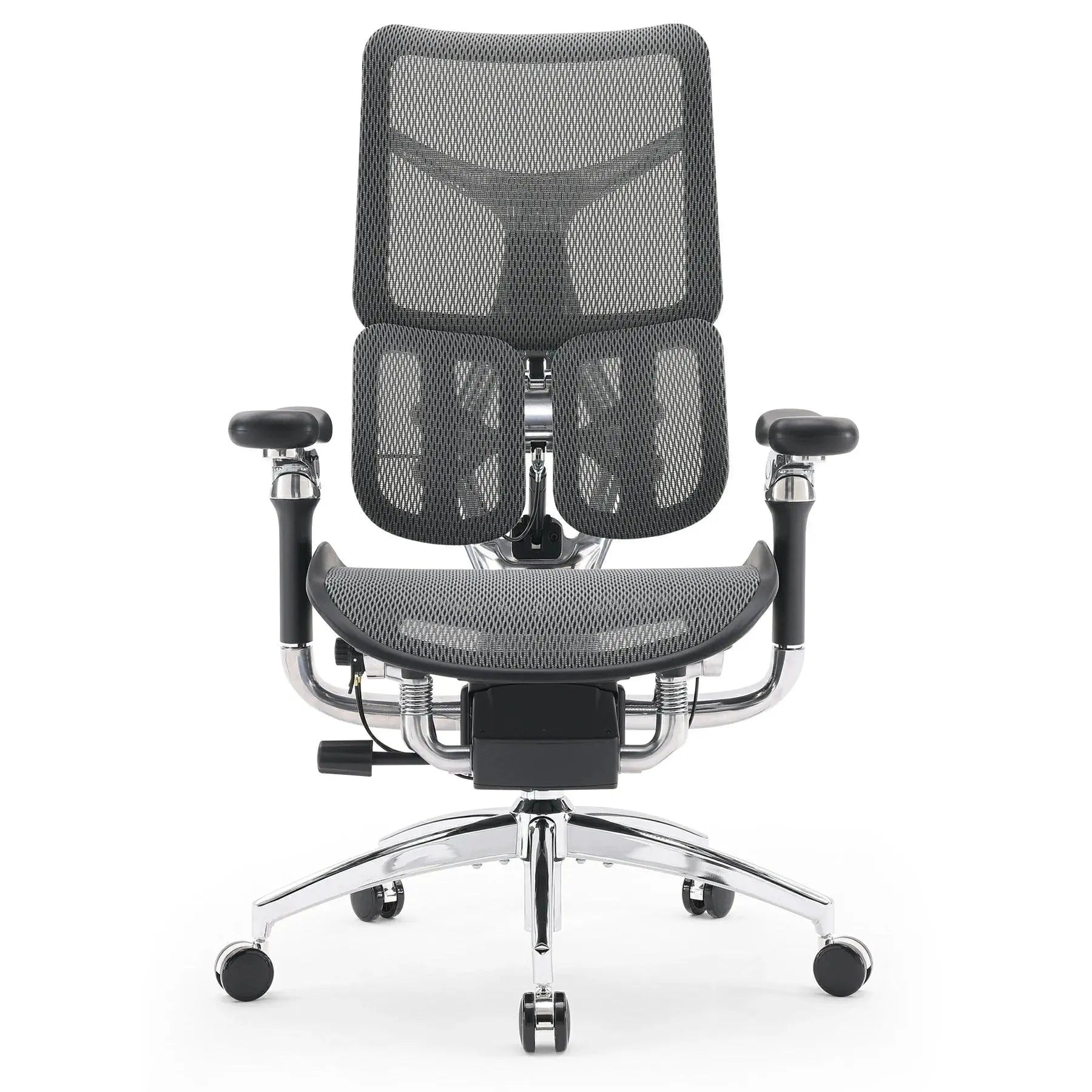
Mitigating these systemic operational losses requires an absolute transition from passive furniture to active ergonomic hardware. This is precisely why risk-mitigation officers and forward-thinking space planners are replacing traditional foam inventories with the Gravity-Defying Ergonomic Mesh Office Chair.
The engineering blueprint of the Gravity-Defying platform completely eliminates the foam degradation variable. By utilizing a proprietary High-Tenacity Elastomeric Polymer Grid, the seating surface delivers perpetual weight distribution that does not decay over time. The matrix continuously self-adjusts to the shifting weight distribution of the user, keeping the pelvis perfectly neutral and preserving the natural lumbar lordosis curve.
Furthermore, its defining hardware advancement—the Reactive Mechanical S-Curve Spine Bridge—functions as a continuous spinal column preservation engine. It requires zero manual calibration from the employee, automatically exerting tailored upward counter-pressure against the L4-L5 vertebrae regardless of recline angle. This active support ensures optimal Occipital Alignment during intensive data analysis or prolonged coding sessions.

With an enterprise-certified 94% Airflow Convection Flux Rate, it completely neutralizes the thermal retention variable, ensuring a cool, stable micro-climate that sustains high-level focus. Protect your enterprise’s most valuable asset—your workforce's physiological endurance.
👉 CLICK HERE TO UPGRADE YOUR ENTIRE CORPORATE WORKSPACE HARDWARE TODAY.
The Orthopedic Evidence: Why Great Ergonomic Office Chairs Redefined the Legal Standards of Workplace Safety
The Inoculation Asset: Evaluating Corporate Seating Infrastructure Through the Lens of Liability Mitigation
Articles connexes

Acoustic Symmetry and Spinal Alignment: Tuning My Workspace for Peak Creative Flow

The Open-Source Posture: Solving the Hidden Thermal and Lumbar Glitches of WFH Seating

Brushing Away the Ache: How My Studio Seating Saved My Posture and My Art

Beyond the Blueprint: A Designer’s Guide to Seat Tension and Creative Endurance

Breaking the Slouch: A First-Person Chronicle of Lower Back Recovery and Creative Stamina

Beyond the Hype: What a Truly Adaptive Workspace Taught Me About Creative Burnout
